
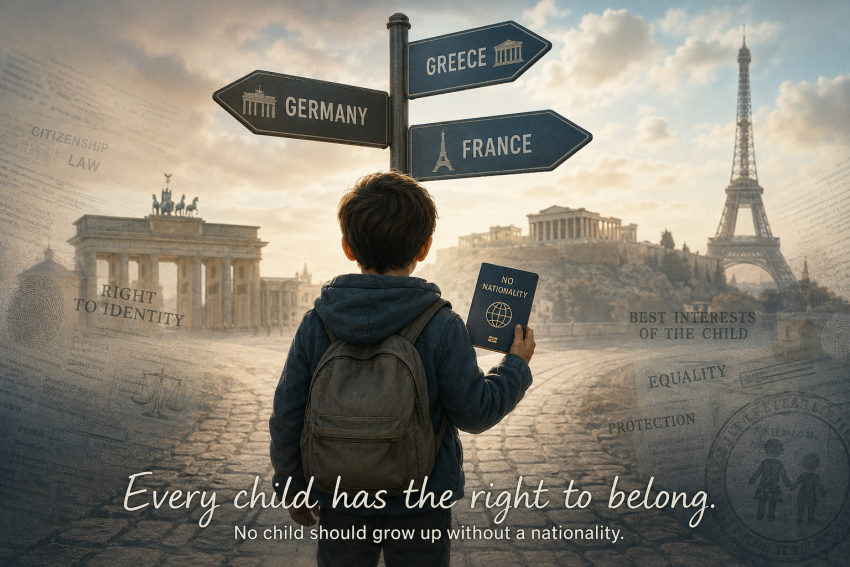
On 12 June 2026, an important change entered into force across the European Union.
While most public attention focused on asylum procedures, border controls, and migration management, one provision received far less attention. For the first time, EU legislation explicitly requires authorities to identify and record indications of statelessness during migration and asylum procedures.
For families raising stateless children, this development is far more important than it may initially appear.
It represents a growing recognition that legal identity is not merely an administrative issue. For a child, identity is the foundation upon which access to rights, education, travel, and future opportunities are built.
Stateless Children: Europe’s Forgotten Children
A stateless child is a child who is not recognized as a citizen by any country under the operation of its laws.
Across Europe, thousands of children continue to live with unresolved nationality status. Some were born during migration journeys. Others became trapped between conflicting legal systems. Some have parents connected to multiple countries that cannot agree on documentation requirements or legal recognition.
For these children, the problem is often invisible.
They attend school, visit doctors, speak the local language, and grow up within European societies. Yet legally, they may belong nowhere.
For years, many European administrations simply recorded such children as having an “unknown nationality” or an “unclear nationality status” without creating effective pathways toward a permanent solution.
The new EU Migration Pact acknowledges that this problem exists and requires authorities to actively identify signs of statelessness.
This is an important first step.
A child cannot receive protection if the legal system does not even recognize the problem.
Recognition Is Important, But Children Need Solutions
Identifying statelessness is valuable, but recognition alone does not change a child’s life.
A child still needs:
- A legal identity.
- Access to nationality.
- Valid identity documents.
- Freedom from long-term legal uncertainty.
- Protection against becoming trapped between different legal systems.
Many families know the frustration of repeatedly proving facts that authorities already know.
Parents are often asked to provide documents that do not exist, obtain certifications from countries they cannot access, or satisfy legal requirements created by conflicting national laws.
The result can be years of uncertainty during the most important years of a child’s development.
Germany: Progress and Remaining Challenges
Germany has introduced important citizenship reforms in recent years.
The 2024 nationality reform reduced residence requirements and expanded the acceptance of multiple citizenship.
For many immigrants, these changes created new opportunities.
However, stateless children continue to face unique challenges.
European organizations and legal experts have repeatedly noted that Germany still lacks a dedicated Statelessness Determination Procedure capable of formally identifying and resolving statelessness in a consistent manner.
This creates a difficult situation for some families.
Authorities may recognize that a child has no effective nationality while simultaneously requiring documents that the child is unable to obtain precisely because no state recognizes them as a citizen.
For affected families, this can feel like a legal circle with no exit.
Greece and Other European Countries Face Similar Problems
The challenge is not unique to Germany.
Greece, like many European countries, has introduced reforms aimed at improving migration and administrative procedures. Yet nationality disputes, documentation problems, and cross-border family situations continue to create difficulties for some children.
A child may be born in one country, live in another, and have parents connected to a third country.
Each country may apply different legal standards.
Each authority may require different documents.
Each institution may believe another institution is responsible.
The child remains caught in the middle.
Why Comparative Law Is Essential
This is where comparative law becomes more than an academic subject.
Comparative law studies how different legal systems solve similar problems.
When dealing with stateless children, comparative law allows policymakers and courts to ask important questions:
- Which countries have effective procedures for identifying stateless children?
- How do different states prevent childhood statelessness?
- Which administrative practices work in reality?
- How can successful solutions be adapted elsewhere?
Modern family and nationality problems increasingly cross borders.
Legal systems can no longer operate as though every problem begins and ends within a single country.
The experiences of Germany, Greece, France, Spain, the Netherlands, and other European states can provide valuable lessons for one another.
Every Stateless Child Represents a Legal Failure
Children do not choose where they are born.
They do not choose which nationality laws apply to them.
They do not create administrative conflicts between states.
When a child grows up without nationality, the problem is usually not a lack of legal rules.
More often, it is a failure of coordination between legal systems.
The child becomes trapped in a space where every authority recognizes the problem but no authority provides a solution.
This is precisely why childhood statelessness remains one of the most important unresolved legal challenges in Europe.
Looking Beyond the New EU Pact
The new EU Migration Pact deserves recognition for bringing greater visibility to statelessness.
For the first time, European authorities are required to actively identify signs that a person—particularly a child—may be stateless.
But identification is only the beginning.
The real objective must be ensuring that every child has a legal identity, access to nationality, and a clear place within society.
Europe has become better at recognizing statelessness.
The next challenge is ensuring that stateless children do not remain stateless adults.
Comparative law can help achieve that goal by allowing legal systems to learn from one another, adopt successful solutions, and place the best interests of the child at the centre of citizenship policy.
Because no child should grow up legally invisible.
source: law-clinic.eu