
- By Evangelos Trimmis in law-clinic.eu
Climate change can destroy the records on which nationality claims depend. The law may survive the disaster while proof becomes impossible to obtain.
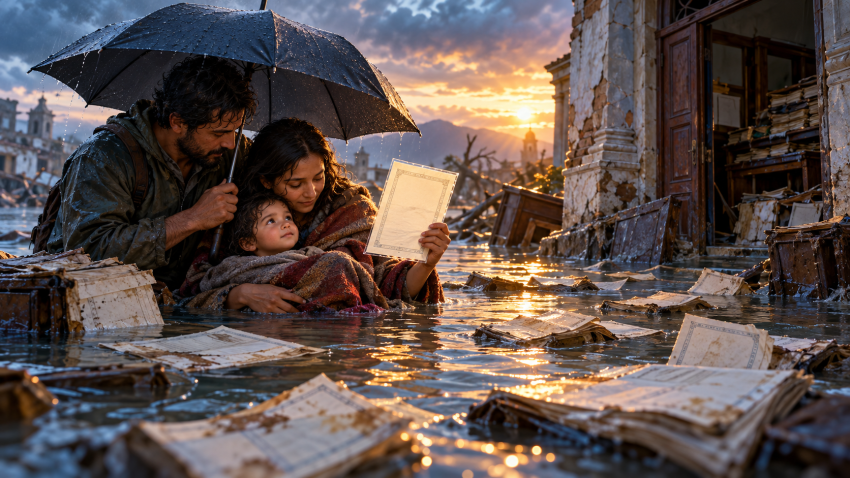
Imagine that a child is born during a period of displacement. The local registry has closed after a flood. The parents’ documents were lost during evacuation. Several years later, another state asks for the child’s birth record and proof of parentage before it will recognise citizenship. What, legally, happened to the child’s nationality?
The destruction of a document does not normally erase a nationality that the child already possesses. But where birth, descent or registration must be established, inaccessible records can prevent officials from determining whether nationality was acquired at all. Where the law makes registration a condition for acquisition, disruption may have an even more direct consequence. These situations must be distinguished rather than described under one convenient label.
On 22 September 2026, UNHCR and the University of Melbourne’s Peter McMullin Centre on Statelessness launched Global Recommendations on Nationality and Statelessness in the Context of Climate Change. They identify risks including damaged or inaccessible civil records, unregistered births during displacement, discrimination in nationality law, and movement across borders. The recommendations address prevention and protection; they do not themselves amend any country’s citizenship law.
The issue reaches far beyond dramatic cases of territory threatened by sea-level rise. A local disaster can interrupt ordinary registration. A displaced parent may be unable to revisit an office to correct a child’s birth entry. An authority in another country may insist on a document that no functioning office can now provide. The child then encounters a problem that resembles statelessness in daily life, even though the legal conclusion still requires examination.
Three questions should be kept separate. First, what does the applicable nationality law say about acquisition at birth or through a parent? Second, did the necessary facts or legal steps occur in this child’s case? Third, what evidence can reasonably establish those matters after records have been lost or administration interrupted? A passport application may expose all three questions, but refusal of a passport does not answer them by itself.
This is where legal systems need administrative resilience. Birth registration should continue, or be recoverable, during displacement. Copies and secure records should be preserved. Alternative evidence should be assessed where original records are unavailable. Officials should explain which fact remains unproved and whether a reasonable substitute can establish it. None of this requires accepting every unsupported nationality claim; it requires a procedure capable of reaching a fair conclusion after disruption.
There is a broader lesson for countries far from the immediate disaster. When a child crosses a border, the receiving authority may become the first institution able to investigate what happened to the records and which state, if any, recognises the child. A rigid demand for documents that cannot be reconstructed can turn an evidentiary crisis into a lasting identity crisis.
The climate recommendations place a new focus on this chain of events. A child should not lose access to legal identity merely because the paper trail was less resilient than the nationality law itself.
Sources: UNHCR and Peter McMullin Centre, Global Recommendations (September 2026); Council of Europe, Compendium of promising practices (2025).