
When a Child Exists in Reality, but Not Fully in Law
Across Europe, thousands of children grow up in a legal grey zone.
They go to school, speak the local language, live with their families, and are often fully integrated into society — yet legally, they remain uncertain who they are in the eyes of the state.
Some have no nationality at all.
Others are trapped between conflicting administrative systems, unregistered identities, or unresolved citizenship procedures.
For years, stateless children were treated as exceptional cases.
Today, that is beginning to change.
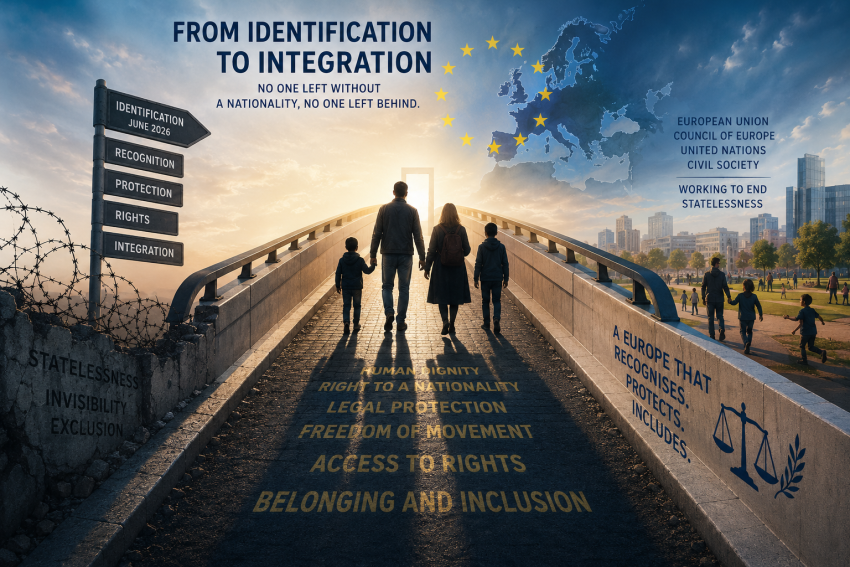
Recent European legal and political developments show that Europe is slowly moving from simply identifying statelessness toward creating real mechanisms of protection.
The shift is still incomplete.
But it is no longer theoretical.
A Major Change in European Thinking
Under the new EU migration and asylum framework, Member States are increasingly expected to identify indicators of statelessness early during administrative procedures.
This may sound technical.
In practice, it is extremely important for children.
For many years, stateless children often disappeared inside administrative assumptions:
- “The child probably has another nationality.”
- “The embassy should solve it.”
- “Another country is responsible.”
- “The parents must first resolve their own status.”
The result was delay after delay — sometimes lasting years.
The newer European approach increasingly recognizes that uncertainty itself creates harm for children.
This is particularly important in cross-border families, mixed-nationality households, refugee situations, and cases involving conflicting civil registry systems between states.
Stateless Children Are Different From Adult Migration Cases
One of the biggest historical mistakes in Europe has been treating children’s nationality problems as if they were ordinary immigration matters.
They are not.
A child does not choose:
- where they are born,
- which country their parents come from,
- whether parents cooperate,
- whether documents exist,
- or whether two states disagree with each other.
Yet children often carry the consequences of failures created entirely by adults and institutions.
When authorities delay recognition for years, the child grows older inside legal uncertainty.
This affects:
- travel rights,
- education access,
- psychological stability,
- long-term residence security,
- financial support,
- identity formation,
- and future employment opportunities.
In some situations, the child effectively becomes “administratively invisible.”
Germany, Greece, and the European Reality
Cases involving Germany and Greece illustrate many of the structural problems Europe is now slowly starting to acknowledge.
Different countries may:
- interpret custody decisions differently,
- require different civil registration procedures,
- apply nationality law differently,
- or refuse responsibility while waiting for another state to act first.
For adults, this already creates legal confusion.
For children, the consequences can become existential.
A child may legally exist in one system but remain incomplete in another.
One country may recognize part of the identity while another demands additional procedures that are practically impossible to complete.
For years, many families were left navigating these contradictions alone.
What is changing now is that European institutions increasingly recognize that statelessness is not merely a documentation issue.
It is a human rights issue.
Europe Is Moving — But Slowly
Several recent European developments point in the same direction:
- stronger recognition of statelessness indicators,
- increased discussion about Statelessness Determination Procedures (SDPs),
- greater attention from the European Parliament,
- Council of Europe guidance,
- and stronger focus from organizations such as European Network on Statelessness and UNHCR.
The core idea is becoming clearer:
A child should not remain trapped indefinitely because institutions cannot coordinate with each other.
This principle sounds obvious.
Historically, however, European systems often operated differently in practice.
The Next Legal Step Europe Must Take
Identification alone is not enough.
Europe is now approaching the next major legal question:
What happens after a child is identified as potentially stateless?
Without a clear legal pathway, identification risks becoming only another administrative label.
The next stage must include:
- effective nationality procedures,
- cross-border administrative cooperation,
- protection against long-term legal limbo,
- and practical solutions focused on the child’s best interests.
This is where Europe still has substantial work to do.
A Moment of Transition
Europe is currently in the middle of a broader transition.
For years, statelessness was treated as a marginal issue affecting only small numbers of people.
Now institutions increasingly recognize that unresolved nationality problems can destabilize entire families across generations.
For stateless children, this shift matters enormously.
The legal system is beginning — slowly — to move away from asking:
“Which authority can avoid responsibility?”
toward asking:
“How do we ensure that a child does not grow up without legal certainty?”
That is not yet a completed transformation.
But it is already a visible one.